
Can Emails or Course of Performance Waive a Contract’s No-Oral-Modification Clause? Florida, North Carolina, and Federal Business Litigation
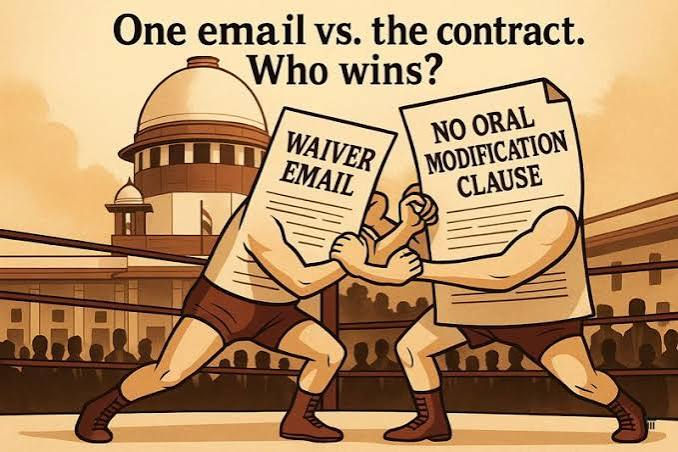
Sometimes. Emails may satisfy a signed-writing requirement if they show assent, authority, and an electronic signature or authenticated sender identity. Course of performance may also support waiver, especially where one side knowingly accepts changed performance without objection, but a no-oral-modification clause still matters and can defeat weak or informal modification arguments.
The practical question is not simply whether someone sent an email or behaved differently for a while. The question is whether the record proves a legally enforceable modification, waiver, estoppel, or course-of-performance defense under the governing law.
The answer depends on…
Whether the contract is governed by Florida law, North Carolina law, another state’s law, or federal law applying state contract principles
Whether the contract involves goods, services, software, real estate, employment, financing, leasing, distribution, licensing, or mixed obligations
Whether the Uniform Commercial Code applies
Whether the contract requires modifications to be signed, in writing, approved by a particular officer, or made through a specific notice process
Whether the email chain contains clear offer, acceptance, consideration, assent, and authority
Whether the email signature block, typed name, sender address, or platform approval qualifies as an electronic signature
Whether the parties agreed to conduct business electronically
Whether the alleged modification would trigger the statute of frauds
Whether the conduct was occasional flexibility or a consistent course of performance
Whether the party claiming waiver materially relied on the changed practice
Whether the other side retracted the waiver and demanded strict compliance
Whether the issue arises before filing suit, at summary judgment, at trial, or on appeal
The starting point: no-oral-modification clauses are important, but not always absolute
A no-oral-modification clause usually says the contract cannot be changed unless the change is in a signed writing. Businesses use these clauses to prevent informal emails, phone calls, field decisions, project-manager comments, payment delays, or operational workarounds from becoming binding contract amendments.
But these clauses do not always end the analysis.
A later email may be a signed writing. A later course of performance may show waiver. A party may be estopped from demanding strict compliance after accepting different performance. And in contracts for goods, the UCC expressly recognizes that an attempted modification that fails a signed-writing requirement can still operate as a waiver.
That said, courts do not treat every informal exchange as a binding amendment. The party claiming modification or waiver usually needs specific evidence of agreement, authority, reliance, and changed performance.
Practical framework: how to evaluate the issue
1. Read the modification clause closely
Start with the contract language.
Ask:
Does the clause require a “writing”?
Does it require a “signed writing”?
Does it require a “signed record”?
Does it require approval by a named officer, executive, lender, board, or owner?
Does it prohibit waiver except in writing?
Does it say failure to enforce a term is not a waiver?
Does it require notice through a specific address or method?
Does it distinguish change orders, amendments, waivers, consents, and approvals?
Does it cover only modifications, or also rescission, waiver, delay, and forbearance?
A clause requiring “written amendments signed by both parties” is different from a clause requiring “prior written approval by the company’s chief executive officer.” The more specific the clause, the harder it may be to prove modification through informal conduct.
2. Decide whether the email is actually a “signed writing”
An email is not automatically a contract amendment. But it may qualify as a written, signed record if it clearly shows agreement and the sender intended to authenticate or approve the change.
Relevant evidence includes:
The sender’s email address
Typed name
Signature block
DocuSign or platform approval
Internal approval chain
Clear subject line
Specific modified terms
Acceptance language
Attached redline or amendment
Prior electronic contracting practice
Follow-up performance consistent with the email
Absence of timely objection
Weak evidence includes:
“Sounds good” without identifying the changed term
Internal emails not sent to the other contracting party
Draft language marked “subject to approval”
Negotiation emails that never reach final agreement
Emails from employees without authority
Operational accommodations that are temporary or disputed
For business disputes, the key is whether the email proves a completed agreement, not merely ongoing negotiation.
3. Separate modification from waiver
Modification and waiver are related but different.
A modification changes the contract. It usually requires mutual assent and may require consideration unless the UCC applies.
A waiver is the intentional relinquishment of a known right. It may arise from words, conduct, or acceptance of performance inconsistent with strict enforcement.
Example: A supplier contract requires delivery by the 1st of each month. For six months, the buyer accepts delivery on the 10th without objection and pays in full. That conduct may support a waiver argument about delivery timing, even if it does not rewrite every future delivery deadline.
The distinction matters because a waiver may sometimes be retracted prospectively if the other party has not materially changed position in reliance on it. A modification is usually harder to retract unilaterally.
4. Identify whether the UCC applies
If the contract is for the sale of goods, Florida and North Carolina UCC provisions may control.
Under UCC-style rules, an agreement modifying a sales contract generally needs no consideration to be binding. A signed agreement that excludes modification except by a signed writing or signed record generally cannot be modified otherwise. But an attempted modification that does not satisfy the signed-writing requirement can still operate as a waiver.
That is a critical distinction.
For goods contracts, emails and course of performance should be evaluated under:
Modification rules
Statute-of-frauds rules
Course-of-performance rules
Waiver and retraction rules
Merchant-specific rules
Any separate contract notice requirements
If the contract is for services, software, real estate, employment, construction, or a mixed transaction, the analysis may shift to common-law contract principles and the parties’ choice-of-law clause.
5. Evaluate course of performance
Course of performance means how the parties actually performed under the contract when repeated performance was required and the other side knew what was happening and accepted or acquiesced without objection.
Evidence may include:
Repeated late payments accepted without default notices
Repeated late deliveries accepted without reservation
Changed billing practices
Different quantity requirements
Changed specifications
New approval workflows
Substituted deliverables
Repeated acceptance of nonconforming goods or services
Continued performance after a disputed change
Internal records showing both sides treated the change as operative
One isolated accommodation is usually weaker than a repeated pattern. A consistent, documented course of performance is stronger.
6. Look for reliance and prejudice
Courts are more likely to credit waiver or estoppel arguments when the party claiming the change materially relied on it.
Reliance evidence may include:
Additional hiring
Inventory purchases
Manufacturing changes
Project scheduling
Capital spending
Foregoing other customers
Continuing performance after default
Accepting reduced payments
Delaying termination
Shipping goods under changed terms
Building software or deliverables to revised specifications
Paying based on the modified arrangement
If the party claiming waiver cannot show reliance or prejudice, the other side may argue that any temporary flexibility was retractable.
Florida contract disputes
Florida law recognizes that written contracts can sometimes be modified by later oral agreement or conduct, even when the contract contains a no-oral-modification clause, if the later modification was accepted and acted upon in a way that would make refusal to enforce it inequitable. Florida’s UCC also provides specific rules for sales contracts, including the rule that an attempted modification that fails a signed-writing requirement may still operate as a waiver.
For Florida businesses, the strongest arguments usually involve:
A clear email amendment
An electronic signature or authenticated written approval
Repeated performance under changed terms
Acceptance of changed performance without objection
Payment under the changed terms
Evidence that the party enforcing the original contract knew of the change
Reliance that makes strict enforcement unfair
Florida risks include:
A contract clause requiring approval by a specific officer
A statute-of-frauds problem
Lack of authority by the employee who sent the email
“No waiver” language in the agreement
Course of performance too short or inconsistent
Failure to object quickly when the other side deviated
Incomplete preservation of email metadata and attachments
North Carolina contract disputes
North Carolina contract disputes require close attention to the contract type. For goods contracts, North Carolina’s UCC includes the same basic modification, rescission, waiver, and retraction structure. An attempted modification that does not satisfy a signed-writing requirement can still operate as a waiver, but North Carolina courts require more than a bare oral promise; later conduct and reliance often matter.
For North Carolina businesses, important facts include:
Whether the contract is a UCC sales contract
Whether the alleged modification satisfies the statute of frauds
Whether emails qualify as electronic records and signatures
Whether both parties agreed to electronic transactions
Whether conduct after the alleged change confirms the new terms
Whether one party materially changed position
Whether strict compliance was later demanded by reasonable notice
Whether the claim is modification, waiver, estoppel, or contract interpretation
North Carolina risks include:
Treating negotiations as final amendments
Relying only on a handshake or phone call
Missing the difference between a new contract, modification, and waiver
Ignoring a contract clause requiring written change orders
Failing to prove authority
Failing to preserve project records, invoices, emails, and payment history
Federal court
Federal courts usually apply state substantive contract law in diversity cases. That means a federal court in Florida or North Carolina may apply Florida or North Carolina modification and waiver law, depending on jurisdiction, choice of law, and Erie principles.
Federal court adds procedural pressure:
The issue may be decided at summary judgment if the written record is clear.
The parties must preserve evidence under federal discovery rules.
Email authentication and metadata can matter.
Course-of-performance evidence may require deposition testimony, invoices, payment records, project records, and Rule 30(b)(6) testimony.
A party seeking injunctive relief must show more than a contract dispute; it must prove the required injunction elements.
Appellate review may turn on whether the issue is a legal question, factual dispute, evidentiary ruling, or mixed issue.
If the case is headed to federal court, counsel should prepare the modification record early rather than treating the issue as a loose business narrative.
Deadlines and timing issues
Modification and waiver issues often become deadline problems.
Calendar:
Contractual notice deadlines
Cure periods
Termination deadlines
Change-order deadlines
Payment-dispute deadlines
Delivery objection deadlines
Warranty notice deadlines
Statute-of-frauds issues
Statutes of limitation for breach-of-contract claims
Injunction hearing deadlines
Discovery deadlines for email preservation and metadata
Expert deadlines if damages depend on the alleged modification
Summary-judgment deadlines
Appeal deadlines after final judgment
In Florida, breach-of-written-contract and breach-of-oral-contract limitations periods may differ. In North Carolina, many contract claims are subject to a three-year limitations period unless a specific rule applies. The exact deadline depends on the claim, contract, accrual date, forum, and governing law.
Evidence to collect
Businesses should preserve:
The executed contract and all amendments
No-oral-modification and no-waiver clauses
Change-order provisions
Notice provisions
Email chains
Attachments
Redlines
Signature blocks
Electronic-signature audit trails
Project-management approvals
Slack, Teams, portal, or CRM communications
Purchase orders
Invoices
Payment records
Delivery records
Acceptance records
Internal approval policies
Board or executive approvals
Course-of-performance history
Objection letters
Default notices
Cure notices
Termination letters
Evidence of reliance
Damages records
Communications showing reservation of rights
The record should show what changed, who approved it, when it changed, how both sides performed afterward, and whether strict compliance was later demanded.
Litigation risks
The main risks include:
Assuming emails always amend contracts
Assuming no-oral-modification clauses are always absolute
Confusing waiver with permanent amendment
Overlooking statute-of-frauds requirements
Relying on someone who lacked authority
Ignoring “no waiver” and “reservation of rights” language
Continuing performance without documenting objections
Accepting changed performance without preserving rights
Failing to retract a waiver clearly and prospectively
Failing to preserve email metadata
Losing the issue at summary judgment because the record is too vague
Losing damages because the modified terms are not specific enough
For businesses, the best time to manage the risk is before the dispute hardens: confirm changes in a formal amendment, reserve rights when accepting nonconforming performance, and object promptly when performance departs from the contract.
Appeal consequences
Modification and waiver issues can be difficult on appeal because the standard of review depends on how the case was decided.
Possible appellate consequences include:
De novo review if the issue was decided on contract interpretation or summary judgment
More deferential review if the trial court or jury resolved disputed facts
Harmless-error arguments if the alleged modification did not affect damages or liability
Preservation problems if the party did not raise waiver, estoppel, statute of frauds, authority, or UCC arguments below
Record problems if emails, attachments, metadata, or course-of-performance evidence were not admitted
Jury-instruction issues if modification and waiver were not properly framed
Fee-shifting exposure if the contract has a prevailing-party fee clause
Injunction consequences if the alleged modification affects exclusivity, confidentiality, noncompete, trade-secret, or supply obligations
A party that wants appellate review should build the record early. The trial court record should identify the specific contract clause, the alleged modification, the waiver theory, the evidence of assent, the evidence of reliance, and the legal standard governing the forum.
Biazzo Law’s appellate-aware approach
Biazzo Law helps businesses evaluate contract disputes before they become expensive litigation or appeal problems. Modification and waiver issues often turn on details that matter later: the exact clause, the email record, the performance history, the evidentiary standard, and the forum.
Biazzo Law assists with:
Florida and North Carolina business litigation
Federal contract disputes
Pre-suit contract assessment
Email and course-of-performance evidence review
Injunction readiness when contract rights require immediate action
Summary-judgment strategy
Appellate preservation
Fee-shifting and exposure analysis
Trial-counsel support
Supreme Court and amicus-aware framing when electronic contracting, UCC, or business-law issues have broader significance
The goal is practical: determine whether the alleged change is enforceable, whether strict enforcement is still available, what evidence will matter, and how the issue affects settlement, injunctions, trial, appeal, and business risk.
Authority block
Relevant authorities include:
Florida Statutes section 672.209, governing UCC sales-contract modification, rescission, waiver, signed-record requirements, and retraction of waiver: https://www.flsenate.gov/Laws/Statutes/2025/672.209
Florida Statutes section 671.205, governing course of performance, course of dealing, usage of trade, and waiver or modification through course of performance: https://www.leg.state.fl.us/statutes/index.cfm?App_mode=Display_Statute&URL=0600-0699/0671/Sections/0671.205.html
Florida Statutes section 668.50, Florida’s Uniform Electronic Transaction Act: https://www.flsenate.gov/Laws/Statutes/2025/0668.50
Professional Insurance Corp. v. Cahill, recognizing that a written contract may be modified by later oral agreement accepted and acted upon in circumstances where refusal to enforce it would work a fraud, even with a written-modification clause: https://law.justia.com/cases/florida/supreme-court/1956/90-so-2d-916-0.html
N.C. Gen. Stat. section 25-2-209, governing UCC sales-contract modification, rescission, waiver, signed-record requirements, and retraction of waiver: https://www.ncleg.gov/EnactedLegislation/Statutes/HTML/BySection/Chapter_25/GS_25-2-209.html
N.C. Gen. Stat. section 25-1-303, governing course of performance, course of dealing, and usage of trade: https://www.ncleg.net/EnactedLegislation/Statutes/HTML/BySection/Chapter_25/GS_25-1-303.html
N.C. Gen. Stat. section 66-315, governing use of electronic records and signatures and agreement to conduct transactions electronically: https://www.ncleg.gov/EnactedLegislation/Statutes/HTML/BySection/Chapter_66/GS_66-315.html
N.C. Gen. Stat. section 66-317, recognizing legal effect of electronic records, electronic signatures, and electronic contracts: https://www.ncleg.gov/EnactedLegislation/Statutes/HTML/BySection/Chapter_66/GS_66-317.html
Varnell v. Henry M. Milgrom, Inc., addressing North Carolina UCC modification, statute-of-frauds, waiver, and the need for conduct beyond a mere promise: https://law.justia.com/cases/north-carolina/court-of-appeals/1985/857sc399-1.html
Son-Shine Grading, Inc. v. ADC Construction Co., recognizing in North Carolina that written contract provisions may be modified or waived by subsequent conduct, even when the instrument provides that only written modifications are binding: https://case-law.vlex.com/vid/shine-grading-inc-v-892628452
15 U.S.C. section 7001, the federal E-SIGN Act, recognizing that electronic signatures, contracts, and records generally may not be denied legal effect solely because they are electronic: https://www.govinfo.gov/link/uscode/15/7001
Internal links
Parent service page: Business & Commercial Litigation — https://www.biazzolaw.com/business-litigation
Related blog post: Can Emails or Text Messages Create or Modify a Business Contract? Florida and North Carolina Guide — https://www.biazzolaw.com/post/can-emails-or-text-messages-create-or-modify-a-business-contract-florida-and-north-carolina-guide
Related blog post: How Does a Limitation-of-Liability Clause Affect the Value of a Business Lawsuit? — https://www.biazzolaw.com/post/how-does-a-limitation-of-liability-clause-affect-the-value-of-a-business-lawsuit-florida-north-c
Contact page: Contact Biazzo Law — https://www.biazzolaw.com/contact-us
Frequently asked questions
Can an email modify a contract with a no-oral-modification clause?
Yes, if the email satisfies the contract’s written-modification requirement and shows clear assent by someone with authority. The email must usually be specific enough to identify the changed term and the parties’ agreement.
Is an email signature block enough to be a signed writing?
Sometimes. Electronic-signature laws can recognize typed names, signature blocks, and electronic records, but the issue depends on intent, authentication, authority, and whether the parties agreed to transact electronically.
Can course of performance waive strict contract terms?
Yes, in some circumstances. Repeated acceptance of changed performance without objection may support waiver, especially when the other party relied on that acceptance.
Does a no-waiver clause prevent waiver by conduct?
It helps, but it may not always be conclusive. Courts still examine the parties’ later conduct, reliance, and whether the party enforcing strict compliance preserved its rights.
Can a party retract a waiver?
Sometimes. Under UCC principles, a party may be able to retract a waiver affecting future performance by giving reasonable notice that strict performance will be required, unless retraction would be unjust because the other party materially relied on the waiver.
What if the contract requires approval by a specific officer?
That requirement can be critical. An email from a project manager, salesperson, or account representative may not modify the contract if the agreement requires approval by a specified officer or executive.
Is one late payment enough to modify payment terms?
Usually not by itself. A single accommodation is weaker than a repeated course of performance. The record should show whether the party accepted the change as a new arrangement or merely tolerated one deviation.
Should the business sue immediately or first clarify the contract terms?
That depends on urgency, damages, notice requirements, and whether immediate relief is needed. Many disputes benefit from a written reservation of rights, cure notice, amendment demand, or litigation strategy review before filing suit.
Schedule a litigation strategy review
If emails, payment history, delivery practices, or course of performance may have changed a business contract, the next step should be evidence-based. Schedule a litigation strategy review with Biazzo Law to evaluate modification, waiver, reliance, notice, damages, injunction options, appeal consequences, and litigation strategy in Florida, North Carolina, or federal court.
This article provides general information, not legal advice. Contract modification and waiver issues depend on the governing law, contract language, communications, performance history, reliance, forum, and procedural posture.



Comments