
Boat Strikes, Due Process and What Congress Can Do in 2027
The short answer
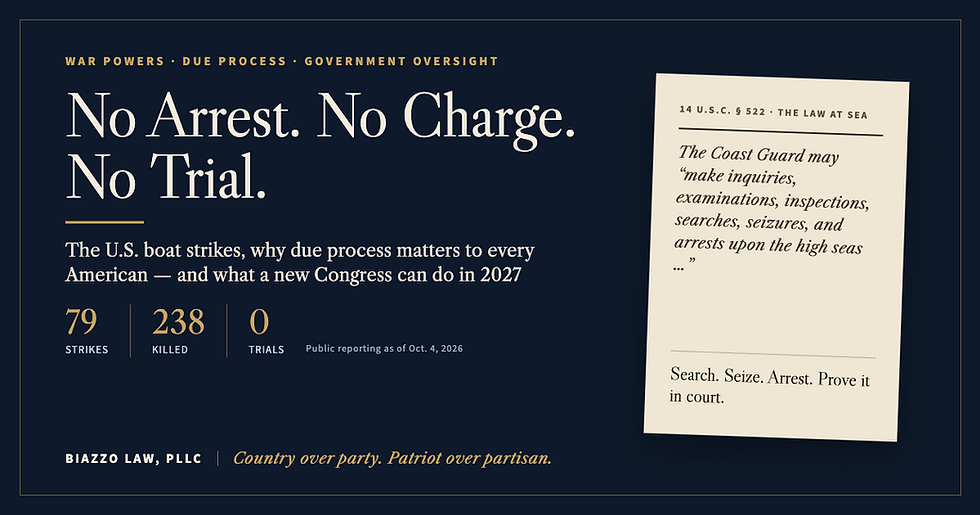
Since September 2, 2025, the U.S. military has carried out at least 79 strikes on small boats in the Caribbean and eastern Pacific, killing at least 238 people, according to a running count by InSight Crime as of October 4, 2026. The government says the boats carried drugs for cartels it has designated as terrorist organizations and that the United States is in an "armed conflict" with them. Congress never authorized that conflict. No one aboard was arrested, charged or tried, and the government has not shown the public evidence about who was killed or what the boats carried.
Drug trafficking is a serious crime. That is exactly why the law has a process for it: the Coast Guard stops the vessel, seizes the evidence, arrests the crew, and prosecutors prove the case in court. When the leader the government accuses of running a narco-terrorist enterprise, Nicolás Maduro, was captured in January 2026, he was brought to a federal courtroom in New York and arraigned. The people on these boats got a missile instead.
You do not have to support drug traffickers, or oppose this administration, to see the problem. A government that can kill people on its own say-so, with no proof shown to anyone, has claimed a power no President of either party should hold. The Congress elected on November 3, 2026 will be seated January 3, 2027, and it can investigate, demand the legal justification, and write clear limits into law. Country over Party. Patriot over Partisan.
What happened: a timeline
We first covered these strikes on Executive Coup, Episode 51, in October 2025, when the reported death toll stood at 27. A year later it is nearly nine times higher. The timeline runs newest first.
Date | Event |
Oct. 4, 2026 | Latest reported strike, in the Caribbean, kills four. Running totals: at least 79 strikes and 238 killed. |
Aug. 23, 2026 | Strikes resume after a gap of more than two months, the longest since the campaign began. |
June 24, 2026 | Federal court in Manhattan hears a FOIA case seeking release of the Justice Department's Office of Legal Counsel memo said to justify the strikes. The government argues the memo can be withheld entirely. |
May 29, 2026 | Death toll passes 200. CBS News reports the military again provided no evidence for its claims about the boat. |
Feb. 2026 | Families of two Trinidad and Tobago men killed in October 2025, who say the men had no ties to drug trafficking, file the first U.S. lawsuit over the strikes, in federal court in Massachusetts. |
Jan. 22, 2026 | House war powers resolution on Venezuela fails on a 215-215 tie. |
Jan. 3–5, 2026 | Nicolás Maduro is captured in Venezuela, flown to New York, arraigned in federal court on narco-terrorism and drug charges, and pleads not guilty. |
Dec. 17, 2025 | House rejects a war powers resolution on the boat strikes, 210-216. |
Dec. 4, 2025 | Adm. Frank Bradley briefs lawmakers, who view video of the September 2 follow-up strike that killed two survivors clinging to wreckage. |
Late Nov.–Dec. 2025 | The Washington Post reports a follow-up strike on September 2 killed survivors; the White House confirms the second strike. |
Nov. 6, 2025 | Senate rejects a Venezuela war powers resolution, 49-51. |
Oct. 21, 2025 | First strike in the eastern Pacific expands the campaign beyond the Caribbean. |
Oct. 16, 2025 | A strike leaves two survivors, who are returned to Ecuador and Colombia rather than prosecuted in the United States. Ecuador declines to charge its citizen. |
Oct. 8, 2025 | Senate rejects a war powers resolution on the boat strikes, 48-51, with two Republicans voting in favor. |
Early Oct. 2025 | The administration tells Congress the United States is in a "non-international armed conflict" with drug cartels it calls "unlawful combatants." |
Sept. 2, 2025 | First strike, on a boat that left Venezuela, kills 11. |
The law in plain English
Drug trafficking at sea is a crime, and the law says how to stop it
Congress has built a complete system for drug smuggling on the high seas. Under 14 U.S.C. § 522, the Coast Guard may board vessels and "make inquiries, examinations, inspections, searches, seizures, and arrests" on the high seas. The Maritime Drug Law Enforcement Act, 46 U.S.C. §§ 70501–70508, makes trafficking aboard stateless and many foreign vessels a federal crime prosecuted in U.S. courts, with penalties up to life in prison. Thousands of smugglers have been convicted this way. Navy ships have long supported these missions, but with Coast Guard law enforcement teams aboard to make the arrests, because federal law, 10 U.S.C. § 275, and Defense Department policy generally bar military personnel from directly searching, seizing and arresting civilians. That rule grows from the same principle as the Posse Comitatus Act: the military fights wars; civilian officers enforce the law.
Proof comes before punishment
In a law enforcement system, the government must prove a person committed a crime, beyond a reasonable doubt, before a judge or jury, before it punishes anyone. A suspected smuggler can be stopped, searched, arrested and, if convicted, imprisoned. No federal drug crime carries the death penalty for a crew member transporting drugs, and no court imposes any sentence without a trial or plea. The strikes skip every step: no boarding, no evidence collected, no identification of the people aboard, no charge, no trial. The government has not shown the public what was on most of the boats or who was killed. Families in Trinidad and Tobago say their relatives were fishermen with no ties to the drug trade.
Only Congress can authorize war
Article I, Section 8 gives Congress the power to declare war. The War Powers Resolution of 1973 allows the President to send forces into hostilities only with a declaration of war, specific statutory authorization, or in response to an attack on the United States. It also requires forces to be withdrawn within 60 days unless Congress authorizes more. None of those conditions has been met. Designating a cartel as a foreign terrorist organization under 8 U.S.C. § 1189 allows sanctions and "material support" prosecutions; it does not authorize the use of military force. Congress's existing authorization for the use of force, passed after September 11, covers those responsible for those attacks, not drug cartels.
Even in war, there are rules
The administration says it is in a "non-international armed conflict" with cartels. Under international law, that label requires an organized armed group engaged in protracted armed violence against the state, not a criminal enterprise selling a product. And even in a real war, the law of armed conflict, including the Second Geneva Convention and the Defense Department's own Law of War Manual, requires protecting the wounded and shipwrecked. Killing people clinging to wreckage, as happened on September 2, 2025, is the conduct that rule exists to prevent. Article 2(4) of the U.N. Charter and the OAS Charter also bar the use of force against other states absent self-defense or Security Council authorization.
Due process and the separation of powers
The Fifth Amendment provides that no person shall be deprived of life "without due process of law." How far that protection reaches foreign nationals on foreign vessels outside U.S. territory is a contested legal question. What is not contested is the constitutional design behind it: Congress defines crimes and authorizes wars, the Executive enforces the law, and courts decide guilt. When one official can decide who is a combatant, who is guilty, and who dies, with no review by either of the other branches, that design has been set aside. As Episode 51 put it, the question is "whether any individual, anywhere, can be killed by a President ordered execution without a trial."
The government's side, fairly stated
The drug crisis is real. Tens of thousands of Americans die from drug overdoses every year. The administration argues cartels are waging something closer to war than ordinary crime, and that arrests have not stopped the flow.
The cartels are designated terrorist organizations. The administration designated several cartels and Venezuelan gangs as foreign terrorist organizations in 2025 and says their members are "unlawful combatants" in a "non-international armed conflict," a framework the United States has used against al-Qaeda.
The President's Article II power. Presidents of both parties have used force without specific congressional approval, from Kosovo to Libya to strikes in Syria. The administration argues the President may act to defend the nation, and the Justice Department has reportedly concluded in a classified opinion that the strikes are lawful and that those carrying them out are not criminally liable.
The September 2 follow-up strike. The commander who ordered it told lawmakers he was not ordered to leave no survivors. Sen. Tom Cotton said after viewing the video that the survivors were trying to right a drug-laden boat "to stay in the fight," and the Republican chairman of the Senate Armed Services Committee later said he saw "no evidence of war crimes."
Congress has had its say. Both chambers voted repeatedly on war powers resolutions, and each one failed, some by a single vote.
Where these arguments run into trouble is the absence of proof and process. The government has not shown the public who was killed or what the boats carried, and two survivors were sent home rather than charged, which is hard to square with the claim that they were enemy fighters or provable criminals. Prior Presidents' uses of force, however debatable, were directed at states or at groups Congress had authorized force against, not at people suspected of a crime that the law already punishes through arrest and trial. A failed vote to stop the strikes is not the same as a vote to authorize them; the Constitution and the War Powers Resolution require Congress to say yes, not merely to fail to say no. And the legal opinion the government relies on remains secret, so neither Congress nor the public can test it.
How this puts Americans at home and abroad at risk
Americans travel, work and fish on the same waters. Millions of Americans take cruises, charter fishing trips and private boats through the Caribbean every year, and American crew members work on commercial vessels in the region. A targeting system that relies on secret intelligence, with no boarding and no identification, has no way to correct a mistake after the missile is fired.
Other countries will claim the same power. If the United States can declare a criminal group an enemy and kill suspected members at sea without trial, other governments can do the same to people they label criminals or terrorists, including Americans. Adversaries already accuse U.S. citizens of crimes to justify detaining them. A precedent of killing on accusation alone hands them a script.
The reach does not stop at foreign nationals. In 2011, an American citizen, Anwar al-Awlaki, was killed in a U.S. strike in Yemen; the Justice Department had written a legal memo analyzing what the Fifth Amendment required before a citizen could be targeted, and that memo was released in 2014 after litigation. The legal opinion behind the boat strikes has not been, so Americans cannot know what limits, if any, it places on targeting a U.S. citizen suspected of drug trafficking.
The logic can come home. The government's theory merges the "war on drugs" with the "war on terror." Drug trafficking happens in every American city. If suspected traffickers are combatants who may be killed at sea, Congress has no statute today that clearly says why the same reasoning could not be applied closer to home. The Posse Comitatus Act and the rules on military law enforcement exist precisely to keep that line bright.
U.S. service members are put at legal risk. Troops follow orders on the assurance that they are lawful. If a court, a future administration or a foreign tribunal later disagrees, the people who pulled the trigger, not the officials who wrote the secret memo, may face the consequences. Clear law from Congress protects them.
Cooperation against real traffickers suffers. Drug interdiction depends on partner nations sharing intelligence. Strikes that kill their citizens without proof erode the trust that leads to real arrests and prosecutions.
What a new Congress can do after January 3, 2027
The current Congress voted on war powers resolutions at least seven times on the boat strikes and Venezuela, and none became law. It held closed-door briefings and viewed the September 2 video, but the legal justification remains secret and the strikes continue. Whichever party holds the majority in the 120th
Congress, it has these tools:
1. Investigate
Demand the legal opinion. Committees can subpoena the Office of Legal Counsel memo and any related opinions, and publish the unclassified legal reasoning. Americans are entitled to know the legal theory under which their government kills people.
Hold public hearings in the Armed Services, Foreign Affairs/Foreign Relations, Judiciary and Intelligence committees on how targets are chosen, what evidence is required, who approves each strike, and what happens to survivors.
Get the facts on every strike. Require a classified and an unclassified accounting of each of the 79-plus strikes: date, location, number killed, identities where known, what intelligence supported it, and whether any drugs were recovered.
Investigate the September 2 follow-up strike fully and in public to the extent possible, including the orders given and the legal advice provided.
Request Inspector General and GAO reviews of the targeting process, the cost of the campaign, and its effect on Coast Guard interdiction and prosecutions.
2. Write clear limits into law
Clarify that an FTO designation does not authorize military force. One sentence in statute would close the gap the administration's theory relies on.
Require Coast Guard law enforcement procedures (boarding, seizure, arrest and prosecution) for suspected drug smuggling at sea, absent a specific authorization from Congress.
Strengthen the War Powers Resolution with a clear definition of "hostilities" that includes lethal strikes regardless of risk to U.S. forces, and an automatic funding cutoff when the 60-day clock runs out.
Require publication of legal opinions that authorize lethal force, with only classified facts redacted.
Protect U.S. persons expressly, by requiring judicial or congressional review before any U.S. citizen or lawful permanent resident could be targeted outside an authorized armed conflict.
3. Use the power of the purse
Congress can bar funds in the defense appropriations and National Defense Authorization Act for lethal strikes on vessels suspected only of drug trafficking, unless Congress has authorized force against the specific group.
4. Preserve the record
Preservation letters to the Defense Department, Justice Department, Southern Command and the intelligence agencies can ensure video, orders, legal advice and intelligence files survive for later review by Congress, courts and inspectors general.
The honest limits
A new law can be vetoed, and overriding a veto takes two-thirds of both chambers. Subpoenas may be met with executive privilege and state secrets claims. Courts may treat military decisions as beyond their reach. But a funding limit in a must-pass defense bill, public hearings, subpoenas and published findings do not require a veto-proof majority. They require a Congress willing to act as a co-equal branch regardless of which party holds the White House.
Why every American should care
Due process is the difference between law enforcement and killing. A police officer who suspects a crime makes an arrest; a prosecutor proves it; a court decides. When the government skips all three, there is no way to know whether it got the right person, and no way to fix it if it did not.
Mistakes cannot be undone. Wrongful convictions are reversed every year because evidence was tested in court. There is no appeal from a missile strike.
Real law enforcement works. The Coast Guard has seized enormous quantities of drugs and helped convict thousands of smugglers, and arrested crews often lead investigators to the organizations behind them. Killing the crew destroys both the evidence and the witness.
Powers outlast Presidents. Whatever authority this President claims to kill suspects on his own judgment, the next President, of either party, inherits it. Ask whether you would trust that power in the hands of the leader you most oppose.
Americans abroad are safer when the United States follows the law. Our strongest protection for citizens detained or targeted overseas is the ability to insist that other nations respect due process. That argument weakens every time the United States sets it aside.
Your representatives answer for war. The Framers gave Congress the war power so that the people's representatives, not one official, decide when Americans kill and die in the nation's name. A Congress that does not use that power gives it away.
Country over Party. Patriot over Partisan. You can want the toughest possible fight against drug cartels and still insist that it be fought within the law. The law is what makes the fight legitimate.
Frequently asked questions
How many people have the U.S. boat strikes killed? At least 238 people in at least 79 strikes in the Caribbean and eastern Pacific between September 2, 2025 and October 4, 2026, according to InSight Crime's running count.
Did Congress authorize the strikes? No. Congress has not declared war on or authorized force against drug cartels. Several war powers resolutions to stop the strikes failed narrowly, but failing to stop an operation is not the same as authorizing it.
What is an extrajudicial killing? A killing by government agents without the judgment of a court, outside a lawful armed conflict and not in immediate self-defense. The term describes the absence of legal process, not the guilt or innocence of the person killed.
Isn't drug smuggling at sea already a crime? Yes. The Maritime Drug Law Enforcement Act makes it a federal felony, and the Coast Guard has authority under 14 U.S.C. § 522 to board vessels and arrest crews, who are then prosecuted in U.S. courts.
What happened on September 2, 2025? The first strike killed 11 people. Reporting later revealed, and the White House confirmed, that a follow-up strike killed two survivors clinging to the wreckage. Lawmakers who viewed the video disagreed sharply about whether it was lawful.
Could this put Americans at risk? Yes. Americans travel and work on the same waters; other countries may copy the precedent; and the secret legal opinion behind the strikes has not been released, so the public cannot know what limits it places on targeting U.S. citizens.
What can Congress do? Subpoena the legal opinion, hold public hearings, require a strike-by-strike accounting, clarify that terrorist designations do not authorize force, require Coast Guard law enforcement procedures, strengthen the War Powers Resolution, and limit funding. The new Congress is seated January 3, 2027.
Is this a partisan issue? It should not be. Members of both parties have voted to rein in the strikes, and the power to kill without trial would pass to every future President.
Stay informed and get involved
The Biazzo Law Government Oversight Program files amicus briefs, pursues Freedom of Information Act litigation, and publishes plain-English analysis so that every American, regardless of party, can hold every branch of government to the Constitution. Watch Executive Coup, share this analysis, and ask every candidate for Congress one question: will you require any President, including one from your own party, to come to Congress before using military force and to follow the law before taking a life?
Country over Party. Patriot over Partisan.
Related reading from Biazzo Law
This article is for general informational and educational purposes only and is not legal advice. Reading it does not create an attorney-client relationship. Biazzo Law, PLLC does not represent any party in the matters discussed. Figures are drawn from public reporting and may change as new information is released. Attorney advertising.


Comments