
Emoluments Clause, Trump Library & Congress in 2027
The short answer
The Constitution contains two Emoluments Clauses. One bars any federal officer from accepting gifts or payments from a foreign government without Congress's consent. The other bars the President from receiving any payment or benefit from the federal government or any state beyond his fixed salary. Both exist for one reason: so that Americans can trust that the President's decisions are made for the country, not for whoever is paying.
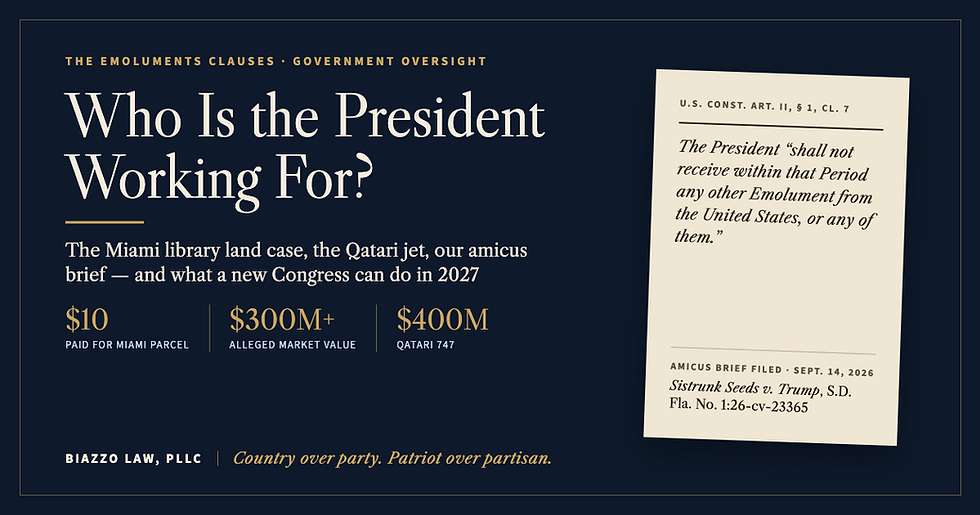
Two matters now test those rules. In May 2025, the Defense Department accepted a Boeing 747 from the government of Qatar, valued at about $400 million, to serve as Air Force One, and the President has said it will go to his presidential library after he leaves office. In 2025, Florida officials transferred a downtown Miami parcel that a federal lawsuit says could sell for more than $300 million to the Donald J. Trump Presidential Library Foundation for a nominal fee. On September 14, 2026, Biazzo Law's Government Oversight Program filed an amicus curiae brief in that case, Sistrunk Seeds Inc. v. Trump, No. 1:26-cv-23365 (S.D. Fla.), arguing that a no-cost transfer of valuable state land to a President-linked foundation falls within the heart of the Domestic Emoluments Clause.
Courts have struggled to decide who has standing to enforce these clauses. Congress does not have that problem. The Foreign Emoluments Clause gives Congress a direct role, consent, and the Congress seated on January 3, 2027 can investigate, demand disclosure and write enforceable rules, whichever party holds the majority. Country over Party. Patriot over Partisan.
What the Emoluments Clauses are, and why the Framers wrote them
An emolument is a profit, advantage or benefit. Samuel Johnson's 1785 dictionary defined it as "profit; advantage." The Constitution uses the word in two places.
Clause | Text | Who it limits | Can it be waived? |
Foreign Emoluments Clause, Art. I, § 9, cl. 8 | "[N]o Person holding any Office of Profit or Trust under them, shall, without the Consent of the Congress, accept of any present, Emolument, Office, or Title, of any kind whatever, from any King, Prince, or foreign State." | All federal officeholders | Yes, only by Congress's consent |
Domestic Emoluments Clause, Art. II, § 1, cl. 7 | The President shall receive a fixed compensation "and he shall not receive within that Period any other Emolument from the United States, or any of them." | The President | No; it has no consent mechanism |
Why they exist
The Framers had watched European monarchs buy the loyalty of foreign diplomats with lavish gifts. When King Louis XVI gave Benjamin Franklin a jeweled snuffbox, Franklin asked Congress for permission to keep it, and Congress consented. That practice became the rule: a federal official cannot quietly accept something of value from a foreign government. The decision belongs to Congress, in public.
The domestic clause addresses a different risk. Alexander Hamilton explained in Federalist No. 73 that if Congress or the states could change the President's finances, they could "tempt him by largesses" and make him "surrender at discretion his judgment to their inclinations." A fixed salary, and nothing more from any government in the United States, keeps the President equally loyal to all fifty states.
Both clauses are preventive. They do not require proof of a bribe or a specific favor. They forbid the financial relationship itself, because by the time a favor can be proven, the damage is done.
How courts have handled them
Emoluments suits during the President's first term were brought by the District of Columbia and Maryland, by more than 200 members of Congress, and by business competitors. They ran into threshold questions about standing. The D.C. Circuit held in 2020 that individual members of Congress lacked standing to sue, and the Supreme Court dismissed the remaining cases as moot after the term ended in 2021, without ruling on what the clauses mean. That history is why the Miami case, and the role of Congress, matter so much now.
The Miami presidential library case
The facts below are allegations or public reporting. None has been proven in court, and the defendants dispute the legal claims.
The land and the plan
The parcel: a Miami Dade College property near the Freedom Tower in downtown Miami. It was appraised at $67 million; the federal complaint alleges it "would likely sell for over $300 million on the open market."
The transfer: Florida officials, through the Governor and Cabinet and the college's trustees, conveyed the land to The Donald J. Trump Presidential Library Foundation, Inc. for a nominal $10. The trustees re-approved the transfer on December 2, 2025, after a state-court challenge over public notice.
The conditions: according to the complaint, the deed requires only that a library, museum or center component be built, or construction begin, within five years.
The plan: reporting describes a 47-story tower with the library on the lower floors and a hotel or office space above. The President has said the building is "most likely going to be a hotel," with the Qatari 747 in the lobby. Construction is estimated at $950 million or more.
The foundation: its named trustees are Eric Trump, Michael Boulos and James Kiley. It has not disclosed its donors. Settlements of lawsuits brought by the President against media companies have directed money to it, including $15 million from ABC, $22 million from Meta and $16 million from Paramount.
The lawsuits
Date | Event |
Sept. 14, 2026 | Biazzo Law files its amicus brief supporting the plaintiffs' opposition to dismissal (ECF No. 65). |
Aug. 19, 2026 | Landmark Legal Foundation and Professor Seth Barrett Tillman file an amicus brief supporting dismissal. |
2026 | Defendants move to dismiss, arguing lack of standing, no cause of action, immunity, the political question doctrine, and that the transfer is not an "emolument" received by the President. Discovery is stayed. |
May 2026 | Sistrunk Seeds Inc. v. Trump, No. 1:26-cv-23365-RAR, is filed in the Southern District of Florida by a Miami urban-farm nonprofit, a Miami Dade College student and downtown residents, represented by the Constitutional Accountability Center and Gelber Schachter & Greenberg. |
Dec. 2025–2026 | In a separate state case, a judge briefly blocks the transfer over open-meetings concerns; after the trustees re-vote on December 2, 2025, the injunction is lifted and that claim is later dismissed without prejudice. |
As of early October 2026, no ruling on the motions to dismiss had been reported. The case is before U.S. District Judge Rodolfo A. Ruiz II.
Our amicus brief
On September 14, 2026, Corey J. Biazzo, Esq., through the Biazzo Law Government Oversight Program, filed a brief amicus curiae in Sistrunk Seeds Inc. v. Trump in support of the plaintiffs' opposition to the defendants' motions to dismiss. The parties that responded to our conferral did not oppose it, and the
Foundation took no position. The brief makes three arguments:
The Domestic Emoluments Clause forbids state largesse to the President. A fixed salary means nothing if a state can add benefits outside it. "A no-cost transfer of valuable state land is a paradigmatic emolument." Even a 1981 Justice Department opinion allowing President Reagan to keep his vested California pension drew the line at gifts and benefits that create an influence concern.
The Constitution looks at substance, not paperwork. A state "may not accomplish indirectly what the Constitution forbids it to do directly." Routing a benefit through a foundation, a public college or family members does not change what it is. Relying on Lebron v. National Railroad Passenger Corp. (1995), the brief argues that labels do not decide constitutional questions; function does.
Courts can and should decide the question. The Domestic Emoluments Clause, unlike the foreign clause, has no congressional-consent mechanism and assigns the question to no other branch, so it presents no political question. Where the President and a state both benefit, political checks are weakest and judicial review matters most.
The brief is careful about its limits. It takes no position on disputed facts, does not challenge ordinary presidential library fundraising, and argues only that these specific allegations, a no-cost conveyance of a uniquely valuable public asset to a family-governed foundation with a planned commercial use, deserve discovery rather than dismissal. As it puts it: "The Framers did not write an anti-corruption provision that can be evaded by paperwork."
The brief also warns of a structural danger: if one state can give the President valuable land, other states will feel pressure to compete for presidential favor with land, tax breaks and subsidies. The Domestic Emoluments Clause exists to prevent that arms race.
An amicus brief does not represent any party, and the court will decide the case on its own analysis.
Other emoluments and conflict-of-interest questions
The Miami case is not the only one. The following matters have been raised in public reporting, lawsuits or congressional letters. Each is disputed, and none has been decided by a court on the merits. They are exactly the kind of questions Congress exists to examine.
The Qatari 747. In May 2025, the Defense Department accepted a Boeing 747-8 from the government of Qatar, valued at about $400 million. The Air Force has spent an undisclosed sum, which lawmakers suggested could top $1 billion, converting it into a temporary Air Force One. The President has said it will go to his presidential library after his term. Congress has not voted to consent. As Executive Coup, Episode 7, put it in May 2025: "regardless of President Trump's stated, proposed intentions with the Jet," acceptance without Congress's consent raises a Foreign Emoluments Clause problem, and a later transfer to a private foundation would raise it squarely.
Foreign-linked cryptocurrency deals. A lawsuit filed October 22, 2026 in federal court in Washington alleges that the President received more than $75 million connected to a sale involving an investment firm backed by a senior UAE official, and that a UAE government-chaired fund used the World Liberty Financial-linked USD1 stablecoin for a $2 billion investment. The White House says the President's assets are in a trust and that "there are no conflicts of interest."
Settlements and donations to the library foundation. Companies with business before the federal government, including media companies awaiting regulatory decisions, have directed tens of millions of dollars to the foundation through settlements of the President's lawsuits. The foundation has not disclosed its donors.
Foreign business ventures. The President's family business has announced real estate and licensing deals in several foreign countries since 2025, some reportedly with partners linked to foreign governments.
None of these items proves wrongdoing. But each involves money flowing from foreign governments, state governments, or parties with interests before the government, to entities connected to the President. The Constitution's answer to that kind of question is not to assume the worst or the best. It is disclosure, and, for foreign benefits, a public vote of Congress.
The other side, fairly stated
"Emolument" may be narrow. Some scholars, including Professor Seth Barrett Tillman, argue that "emolument" means compensation for official services, not every benefit, so a land gift to a charity is not an emolument at all.
The foundation is not the President. The defendants point out that the land went to a separate nonprofit corporation whose charter bars using its net earnings or assets to benefit the President or any individual.
Presidential libraries are a long tradition. States and cities have competed to host presidential libraries for decades, often providing land or financial support. Defendants say Florida's gift is in that tradition.
The jet was a gift to the United States. The administration says the Qatari 747 was given to the U.S. Air Force, not to the President personally, which would place it outside the Foreign Emoluments Clause. Federal law, the Foreign Gifts and Decorations Act, already governs gifts accepted on behalf of the United States.
Courts are the wrong forum. Defendants argue the plaintiffs lack standing, that no statute gives them a cause of action, and that disputes like this belong to the political process.
These are serious arguments, and a court may accept some of them. But even if a court dismisses the Miami case on standing, that would not mean the transfer is constitutional; it would mean these plaintiffs cannot ask that question in court. That is precisely why Congress matters. Prior libraries were not paired with a for-profit hotel tower on land given during the President's own term. And if the 747 belongs to the United States, Congress can say so in law and decide where it goes when this term ends.
What a new Congress can do after January 3, 2027
The Foreign Emoluments Clause makes Congress the gatekeeper: no foreign present without its consent. A Congress that never votes, never asks, and never objects has given that power away by default. Whichever party holds the majority in the 120th Congress, it can act.
1. Investigate
Require a full accounting of payments and benefits from foreign governments, and from state governments, to the President, his family businesses, and the library foundation since January 20, 2025.
Examine the Qatari 747: the terms of acceptance, the full cost of the retrofit to taxpayers, the security review, and any plan to transfer it to the library.
Examine the Miami transfer and the library foundation's donors, governance and commercial plans.
Review foreign-linked business and crypto deals and any government decisions that affected the counterparties, through hearings, subpoenas and requests to Inspectors General and the Government Accountability Office.
2. Write enforceable rules
Create a cause of action and clear standing so that emoluments disputes can be decided on the merits rather than dismissed on threshold grounds.
Require disclosure of foreign-government payments to businesses owned by the President or Vice President, and of every donor to a sitting President's library foundation above a set amount.
Set rules for presidential libraries: no land, tax or financial gifts from states while the President is in office; no commercial ventures that benefit the President or family; and a clear rule that gifts to the United States stay with the United States.
Establish a public process for consent under the Foreign Emoluments Clause, so that silence is never treated as approval.
3. Use the power of the purse
Congress can bar appropriated funds from being used to transfer government property, including the 747, to a private foundation, and can require a public report on the cost of the aircraft program.
4. Preserve the record
Preservation letters to the White House, the Defense Department, the State Department and the library foundation can ensure that records of these arrangements survive for future review.
The honest limits
A new law faces a possible veto, and overriding takes two-thirds of both chambers. Executive privilege claims may slow subpoenas. Congress cannot prosecute anyone. But hearings, subpoenas, disclosure demands, consent votes, and funding conditions in must-pass bills do not require a veto-proof majority. They require a Congress willing to act as a co-equal branch regardless of which party holds the White House.
Why every American should care
You deserve to know who the President works for. When foreign governments, states or companies with business before the government give the President or his family something of value, Americans cannot tell whether a decision on trade, arms sales, tariffs, mergers or disaster aid was made for the country or for the giver.
Your state should not have to bid for the President's favor. If one state can give the President land worth hundreds of millions of dollars, every state faces pressure to compete. Federal disaster aid, highway funding and military bases should go where the need is, not where the gifts are.
Public property belongs to the public. A downtown parcel owned by a public college, or a $400 million aircraft retrofitted at taxpayer expense, are public assets. How they are used should be decided openly.
The rule cuts both ways. Whatever a sitting President of one party may accept, the next President, of either party, may accept too. A rule that protects against a President you oppose has to apply to the one you support.
Foreign governments play a long game. The Framers understood that a gift from a foreign power is rarely free. The Foreign Emoluments Clause makes Congress the gatekeeper so that no single official can be quietly placed in a foreign government's debt.
Corruption erodes trust in everything else. When people believe decisions are for sale, they stop trusting elections, courts and institutions. Clear, enforced rules are how a republic keeps that trust.
Country over Party. Patriot over Partisan. You do not have to believe any particular official is corrupt to insist on the rules that keep every official honest.
Frequently asked questions
What is the Emoluments Clause? There are two. The Foreign Emoluments Clause (Art. I, § 9, cl. 8) bars federal officials from accepting gifts or payments from foreign governments without Congress's consent. The Domestic Emoluments Clause (Art. II, § 1, cl. 7) bars the President from receiving any benefit from the federal government or any state beyond his fixed salary.
What is an emolument? A profit, advantage or benefit. Founding-era dictionaries defined it broadly; some scholars argue it means only compensation for official services.
What is the Miami Trump presidential library lawsuit? Sistrunk Seeds Inc. v. Trump, No. 1:26-cv-23365 (S.D. Fla.), challenges Florida's transfer of a downtown Miami parcel to the Trump presidential library foundation for a nominal fee as a violation of the Domestic Emoluments Clause. Motions to dismiss are pending.
Did Biazzo Law file a brief? Yes. On September 14, 2026, Corey J. Biazzo, Esq. filed an amicus curiae brief through the Government Oversight Program supporting the plaintiffs' opposition to dismissal, arguing that a no-cost transfer of valuable state land to a President-linked foundation is a paradigmatic emolument.
Did Congress consent to the Qatari jet? No congressional vote to consent has been reported. The administration says the jet was a gift to the U.S. Air Force rather than to the President.
Why haven't courts settled these questions? Most earlier emoluments suits were dismissed for lack of standing or as moot, so courts have never fully ruled on what the clauses mean as applied to a sitting President.
What can Congress do? Investigate foreign and state benefits, require disclosure, create a clear way to enforce the clauses in court, set rules for presidential libraries, hold consent votes, and attach conditions to funding.
Is this a partisan issue? It should not be. The clauses bind every President, and a rule that is not enforced now will not be available against the next one.
Stay informed and get involved
The Biazzo Law Government Oversight Program files amicus briefs, pursues Freedom of Information Act litigation, and publishes plain-English analysis so that every American, regardless of party, can hold every branch of government to the Constitution. Watch Executive Coup, share this analysis, and ask every candidate for Congress one question: will you require any President, including one from your own party, to disclose foreign and state benefits and to come to Congress for consent?
Country over Party. Patriot over Partisan.
Related reading from Biazzo Law
This article is for general informational and educational purposes only and is not legal advice. Reading it does not create an attorney-client relationship. Biazzo Law, PLLC participates in Sistrunk Seeds Inc. v. Trump only as amicus curiae and does not represent any party. Allegations described here have not been proven. Litigation is ongoing, and later developments may change the analysis. Attorney advertising.


Comments