
Broadview Six Case Enters New Accountability Phase: Defendants Seek Fees, Discovery, and Special Counsel After Grand Jury Misconduct Concerns
- Biazzo Law
- Jun 23
- 13 min read
Updated: Jul 23
By Biazzo Law, PLLC
June 23, 2026
The Broadview Six prosecution is no longer just a dismissed criminal case.
It has become a major government oversight case about prosecutorial power, grand jury integrity, public transparency, and whether federal prosecutors can avoid accountability after a prosecution collapses under the weight of alleged misconduct.
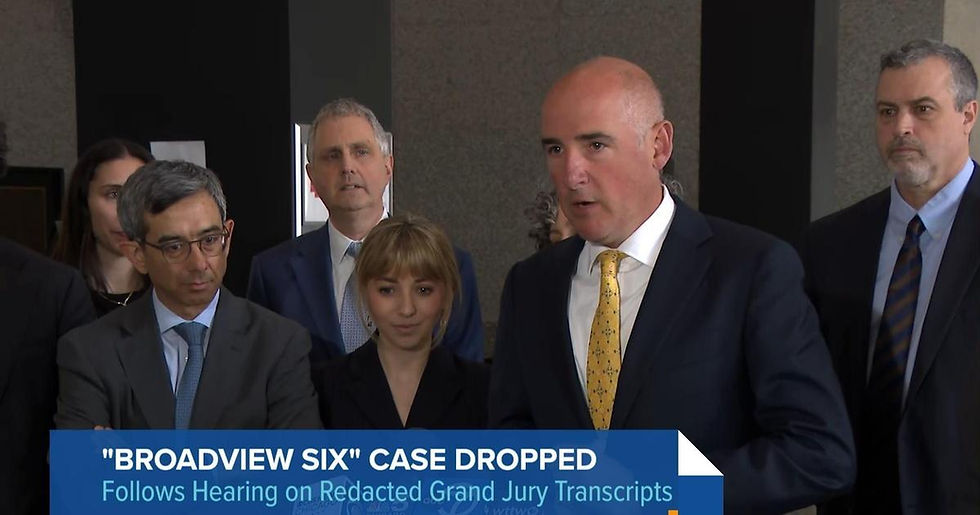
The criminal charges against the Broadview Six defendants were dismissed with prejudice after the Court reviewed unredacted grand jury transcripts and identified serious concerns about how prosecutors handled the grand jury and what the government had redacted from the version initially provided to the Court.
Now, the case has entered a new phase.
The defendants have filed motions seeking attorneys’ fees under the Hyde Amendment, post-dismissal discovery into the government’s conduct, and appointment of outside special counsel to investigate whether prosecutors or others should face criminal contempt proceedings.
These filings matter because dismissal with prejudice ended the prosecution, but it did not answer the larger public question:
Who knew what, when did they know it, and did federal prosecutors or supervisory officials conceal misconduct from the Court?
Quick Answer: What Is the New Development in the Broadview Six Case?
The defendants are now seeking post-dismissal accountability.
They are asking the Court for three major forms of relief:
First, attorneys’ fees and litigation expenses under the Hyde Amendment. The defendants argue that the prosecution was vexatious, frivolous, or brought in bad faith.
Second, discovery after dismissal. The defendants argue they are entitled to targeted discovery to determine the full scope of the alleged misconduct, including how the defendants were selected for prosecution and whether Main Justice or White House officials had communications about the case.
Third, appointment of special counsel. The defendants ask the Court to appoint outside counsel to investigate possible criminal contempt by prosecutors, supervisors, and others involved in the prosecution and alleged cover-up.
The case is now about more than whether charges were properly dismissed. It is about whether the justice system will uncover how the prosecution happened in the first place.
Background: What Was the Broadview Six Case?
The Broadview Six case arose from a September 26, 2025 protest near the Broadview Service Staging Area, an ICE facility in Broadview, Illinois.
The federal government charged six defendants in connection with the protest. The original indictment included a felony conspiracy charge under 18 U.S.C. § 372 and individual charges under 18 U.S.C. § 111(a)(1), which concerns forcibly assaulting, resisting, opposing, impeding, intimidating, or interfering with certain federal officers.
The case was politically and constitutionally sensitive from the beginning because it involved immigration enforcement, public protest, federal prosecutorial discretion, and the government’s use of a rarely invoked felony conspiracy statute against protesters.
The defense challenged the prosecution aggressively, including by seeking access to grand jury materials showing how prosecutors instructed the grand jury on the law.
That request eventually led to the collapse of the case.
See our Prior Article on this Matter: Link “Federal Protest Prosecution Dismissed With Prejudice After Judge Finds Serious Grand Jury Misconduct Concerns” to:
The May 21 Hearing: The Turning Point
The turning point came after Judge April M. Perry reviewed the unredacted grand jury transcripts.
At the May 21, 2026 hearing, the Court stated that it had identified problems far more serious than legal-instruction issues. The Court described concerns involving improper prosecutorial vouching, improper substantive communications with grand jurors outside the grand jury room, and the prosecutor excusing grand jurors who disagreed with the government’s case from the deliberation process.
Most troubling, the Court stated that these issues had been redacted out of the transcripts initially provided to the Court.
That is the key fact driving the new filings.
Mistakes before a grand jury are serious. But redacting those mistakes from a judge conducting in camera review raises a different and deeper problem: candor to the Court.
The Court said that trust had been broken.
The government then dismissed the remaining charges with prejudice.
Dismissal With Prejudice Was Not the End
A dismissal with prejudice is powerful. It means the government cannot simply refile the same charges in the same case.
But dismissal with prejudice does not answer every question.
It does not determine whether the defendants should be reimbursed for the cost of defending themselves. It does not determine whether prosecutors or supervisors should face sanctions. It does not determine whether the Court should appoint special counsel. It does not determine whether Main Justice, the U.S. Attorney’s Office, or political officials influenced the prosecution.
That is why the case continues.
The defendants are now using post-dismissal motions to pursue what they describe as the full factual record.
The Hyde Amendment Motion: Why the Defendants Seek Fees
The defendants’ first major post-dismissal filing was a motion for attorneys’ fees and litigation expenses under the Hyde Amendment.
The Hyde Amendment allows a prevailing criminal defendant to recover reasonable attorneys’ fees and litigation expenses if the Court finds that the government’s position was vexatious, frivolous, or in bad faith.
The defendants argue that they are prevailing parties because the charges were dismissed with prejudice. They also argue that the prosecution was infected by misconduct before the grand jury and by later efforts to hide that misconduct from both the defense and the Court.
In plain English, the defendants are saying:
It is not enough that the government dropped the case. The government should pay for forcing defendants to defend against a prosecution allegedly tainted by misconduct and concealment.
Why the Hyde Amendment Matters
Hyde Amendment awards are rare.
That is why this filing is significant.
The defendants are not merely asking for ordinary costs. They are asking the Court to find that the government’s litigating position crossed a serious line.
The Hyde Amendment standard is demanding. A defendant generally must show that the government’s position was vexatious, frivolous, or in bad faith. But the defendants argue that this case meets that standard because the alleged misconduct was not limited to an isolated mistake. Instead, they claim the misconduct was pervasive and included a months-long effort to prevent the Court and defendants from seeing what happened before the grand jury.
That is a serious accusation. The Court has not yet ruled on the Hyde Amendment motion. But the filing places the fee issue squarely before the Court.
Catherine Sharp’s Separate Fee Motion
Catherine Sharp, whose charges were dismissed earlier than the remaining defendants, has filed her own Hyde Amendment motion.
Her filing is important because she was dismissed before the grand jury misconduct was publicly revealed. She argues that her motion should be treated as timely through equitable tolling because she could not have filed a good-faith Hyde Amendment motion within thirty days of her dismissal when the factual basis for the motion had not yet been uncovered.
Sharp also adopts the arguments made by her co-defendants and seeks access to the same grand jury materials and related evidence.
Her position reinforces the broader point: if the government concealed the basis for a fee claim, then a defendant should not be penalized for failing to file before the misconduct became known.
The Discovery Fight After Dismissal
The defendants are also seeking discovery after dismissal.
That is one of the most important updates.
The government has reportedly informed defense counsel that it will not contest that defendants are entitled to recover attorneys’ fees and costs, while not admitting or conceding the underlying facts. That is a major practical development, but it does not end the case.
The defendants argue that discovery is still necessary.
They want information about:
the materials presented to the grand jury;
the decision to indict the defendants;
the decision to continue or dismiss the prosecution;
who approved or participated in the redactions;
communications with Main Justice;
communications with the White House;
communications involving senior DOJ officials;
the alleged cover-up of grand jury misconduct; and
similar grand jury issues in other immigration-related cases.
The defendants’ position is straightforward: if the government’s own conduct is the reason fees are owed, then discovery is needed to determine the full scope of that conduct and to ensure any fee resolution is fair.
Why Discovery Matters Even After the Case Was Dismissed
The government may argue that once the charges are gone, the criminal case is over.
But the defendants argue that the Court still has live issues to resolve: fees, sanctions, possible contempt, preservation of evidence, and the scope of any misconduct.
That is why the discovery request matters.
Without discovery, the public may never know whether the misconduct was limited to a few prosecutors or whether it involved supervisors, the U.S. Attorney’s Office front office, Main Justice, or political officials.
This is where the case becomes a government oversight issue.
A prosecution can end, but accountability should not end if there are unresolved questions about how the government used its power.
The Motion to Appoint Special Counsel
The most serious new filing asks the Court to appoint outside special counsel to investigate possible criminal contempt.
The defendants rely on Federal Rule of Criminal Procedure 42 and 18 U.S.C. § 401.
Rule 42 governs criminal contempt proceedings. Section 401 gives federal courts power to punish contempt, including misbehavior that obstructs the administration of justice and misbehavior by officers of the Court in their official transactions.
The defendants argue that DOJ cannot credibly investigate itself. They contend that outside special counsel is necessary because the alleged misconduct may involve prosecutors, supervisors, the U.S. Attorney’s Office front office, and potentially officials in Washington, D.C.
Their argument is simple:
No one can credibly investigate themselves.
What Would Special Counsel Investigate?
The proposed special counsel would investigate whether prosecutors or others engaged in criminal contempt.
The potential focus would include:
grand jury presentations;
alleged improper vouching;
alleged communications with grand jurors outside the grand jury room;
alleged exclusion of dissenting grand jurors from deliberations;
the decision to present the case repeatedly after the grand jury initially did not indict;
the decision to redact grand jury materials submitted to the Court;
the failure to correct the Court’s misunderstanding about the redactions;
who knew about the misconduct;
who approved the redactions;
whether there was pressure from supervisory officials;
whether Main Justice or political officials influenced the prosecution; and
whether any conduct obstructed the administration of justice.
The Court has not ruled on this motion. But the request itself is extraordinary.
Why the Grand Jury Issues Are So Serious
The grand jury is not supposed to be a rubber stamp.
In federal felony cases, the Fifth Amendment requires a grand jury indictment. That protection exists because the grand jury is supposed to stand between the government and the accused.
But that protection depends on the government respecting the grand jury’s independence.
If prosecutors vouch for the case, communicate improperly with grand jurors, remove dissenting grand jurors from deliberations, or conceal those events from the Court, the grand jury’s constitutional role is compromised.
That is why this case is so troubling.
The issue is not just whether one prosecution went wrong. The issue is whether the grand jury process was manipulated in a way that undermines one of the Constitution’s oldest safeguards.
The Redactions Are the Core Accountability Issue
The most unsettling part of the case is the redaction issue.
According to the defense, the government resisted requests for grand jury materials for months. When the Court ordered in camera review, the government submitted redacted transcripts. The defense argues that those redactions omitted the very misconduct the Court needed to evaluate.
The Court later saw the unredacted transcripts and expressed serious concern.
That is the accountability issue.
A judge cannot conduct meaningful review if the government controls the record by redacting the most important facts.
The justice system depends on candor. That is especially true when the party appearing before the Court is the United States.
Prosecutors Are Not Ordinary Litigants
Federal prosecutors represent the United States. Their role is not simply to win. Their duty is to seek justice.
That duty carries special obligations of candor, fairness, restraint, and constitutional fidelity.
The Broadview Six filings allege that the government violated those duties not only in the grand jury room, but also in later litigation before the Court.
If true, that is not merely a technical problem. It is a public trust problem.
When the government prosecutes citizens, the process must be fair. When the government seeks an indictment, the grand jury must be independent. When the government submits materials to a judge, the submission must be candid. When misconduct is discovered, the response must be transparency, not concealment.
The Main Justice and Washington, D.C. Questions
The defendants also seek discovery into whether officials outside the Northern District of Illinois influenced the case.
They point to public statements, the involvement of high-ranking DOJ officials in public messaging, and alleged reasons to investigate whether Main Justice or other Washington officials had communications about the prosecution.
Those allegations have not been decided by the Court.
But they are serious enough to explain why the defendants are seeking discovery and why they want special counsel from outside DOJ.
If the prosecution was influenced by political pressure, that would raise profound constitutional concerns. Prosecutorial power must never be used as a political weapon against disfavored speakers, protesters, activists, journalists, or perceived opponents.
That principle is nonpartisan.
It applies regardless of which party controls the White House.
Why This Case Is Constitutionally Unsettling
The Broadview Six case implicates several constitutional principles.
First Amendment: The case arose from a protest. Even when the government prosecutes conduct, not speech, protest-related prosecutions require special care because aggressive charging can chill lawful dissent.
Fifth Amendment: The grand jury is a constitutional safeguard. If the grand jury process is manipulated, the accused loses a critical protection.
Due Process: A defendant is entitled to a fair process, not a prosecution driven by hidden misconduct or concealed evidence.
Separation of Powers: Courts must be able to supervise proceedings before them and protect the integrity of their own process.
Public Accountability: The public has a right to understand how prosecutors use criminal power, especially in politically sensitive cases.
The case is unsettling because it suggests that dismissal may only reveal the surface of a deeper institutional problem.
Why This Matters Beyond the Broadview Six
This case should matter to every American.
A person does not need to agree with the defendants’ politics, protest activity, immigration views, or public statements to care about this case.
The issue is bigger than one protest.
The question is whether the federal government can bring serious charges, resist disclosure, redact key misconduct from judicial review, and then end the case without full accountability.
If that can happen in one protest case, it can happen elsewhere.
Government power must have limits. Prosecutorial power must have oversight. Courts must be able to trust the government. Citizens must be able to trust that criminal law is not being used for political messaging.
Biazzo Law Government Oversight Program
The Biazzo Law Government Oversight Program exists to highlight exactly these kinds of issues: constitutional accountability, government transparency, due process, prosecutorial overreach, and the lawful limits of government power.
Government oversight is not anti-law-enforcement.
It is pro-Constitution.
The public should want prosecutors to enforce the law. But the public should also demand that prosecutors obey the law, respect the courts, preserve grand jury independence, and tell the truth.
That is the purpose of nonpartisan government oversight.
Learn more about the Biazzo Law Government Oversight Program here:https://www.biazzolaw.com/biazzolawgovernmentoversight
Biazzo Law’s U.S. Supreme Court Practice
The Broadview Six case also raises issues that can reach far beyond the district court level.
Questions involving grand jury independence, prosecutorial misconduct, criminal contempt, due process, sanctions, and court authority to appoint outside counsel can create significant appellate and even Supreme Court issues.
Biazzo Law’s U.S. Supreme Court practice focuses on high-stakes constitutional questions, appellate strategy, amicus curiae briefing, and issues involving the structure of government power.
Cases like Broadview Six remind us that constitutional litigation is not abstract. It affects real people, real prosecutions, and real limits on government authority.
Learn more about Biazzo Law’s U.S. Supreme Court practice here:https://www.biazzolaw.com/biazzolawscotuspractice
What Happens Next?
Several issues remain pending or unresolved.
The Court must decide whether to award Hyde Amendment fees.
The Court must decide whether to permit post-dismissal discovery.
The Court must decide whether Catherine Sharp’s separate fee motion should be deemed timely.
The Court must decide whether sanctions or contempt proceedings are appropriate.
The Court must decide whether to appoint outside special counsel.
The government and defense may negotiate the amount of fees and costs.
The public may learn more if discovery is ordered or if further hearings are held.
The most important question is whether the Court will allow the case to end with dismissal alone or
whether it will require a fuller accounting of what happened.
Key Takeaway
The Broadview Six prosecution ended with dismissal with prejudice.
But the accountability phase has just begun.
The defendants now seek fees, discovery, and special counsel. Their filings allege that prosecutors committed misconduct before the grand jury, concealed that misconduct from the Court, and attempted to avoid disclosure until the Court forced the issue.
The Court has not yet decided those new motions. But the allegations are serious, the constitutional stakes are high, and the public deserves answers.
The grand jury must remain independent.
Prosecutors must be candid.
Courts must be able to trust the government.
And citizens must be able to know when government power has crossed the line.
Frequently Asked Questions
What is the Broadview Six case?
The Broadview Six case is a federal prosecution arising from a protest near the Broadview ICE facility in Illinois. The government initially charged six defendants, including a felony conspiracy count and individual charges related to allegedly impeding a federal agent.
What happened to the charges?
The charges were dismissed with prejudice after the Court reviewed unredacted grand jury transcripts and identified serious concerns involving prosecutorial conduct, grand jury proceedings, and redactions from materials initially provided to the Court.
What does dismissal with prejudice mean?
Dismissal with prejudice means the government cannot simply refile the same charges in that case. It is a final dismissal of those charges.
What is the Hyde Amendment?
The Hyde Amendment allows a prevailing criminal defendant to recover attorneys’ fees and litigation expenses if the Court finds that the government’s position was vexatious, frivolous, or in bad faith.
Why are the defendants seeking attorneys’ fees?
The defendants argue that the prosecution was tainted by grand jury misconduct and alleged concealment from the Court. They claim the government’s position was vexatious, frivolous, or brought in bad faith.
Why are the defendants seeking discovery after dismissal?
The defendants argue that discovery is needed to determine the full scope of the alleged misconduct, including who knew about the grand jury issues, who approved redactions, and whether Main Justice or political officials influenced the prosecution.
What is the motion to appoint special counsel?
The defendants ask the Court to appoint outside special counsel to investigate whether prosecutors or others committed criminal contempt by obstructing the administration of justice or engaging in misconduct as officers of the Court.
Has the Court found criminal contempt?
No. The Court has not found criminal contempt. The defendants are asking for an investigation and possible prosecution if the facts support it.
Why does this matter to the public?
The case raises major issues involving prosecutorial power, protest rights, grand jury independence, due process, court supervision, and public trust in the justice system.
Is this a partisan issue?
No. Prosecutorial accountability is a constitutional issue. The same principles apply regardless of which political party controls the government.
Is this legal advice?
No. This article is for public education and general legal analysis only. It does not create an attorney-client relationship and should not be relied upon as legal advice.
See the Court's Hearing Transcripts from May 21, 2026 Discussing the Court's Review of the Grand Jury Transcripts that Had Been Previously Redacted:
See Defendant's Motion with Timeline of Events Leading to Disclosure of Redacted Materials:


Comments